Smart Traffic Management and Urban Computing
Optimizing gridlock and municipal routing through IoT sensor deployment, edge-processed computer vision, and adaptive control systems.
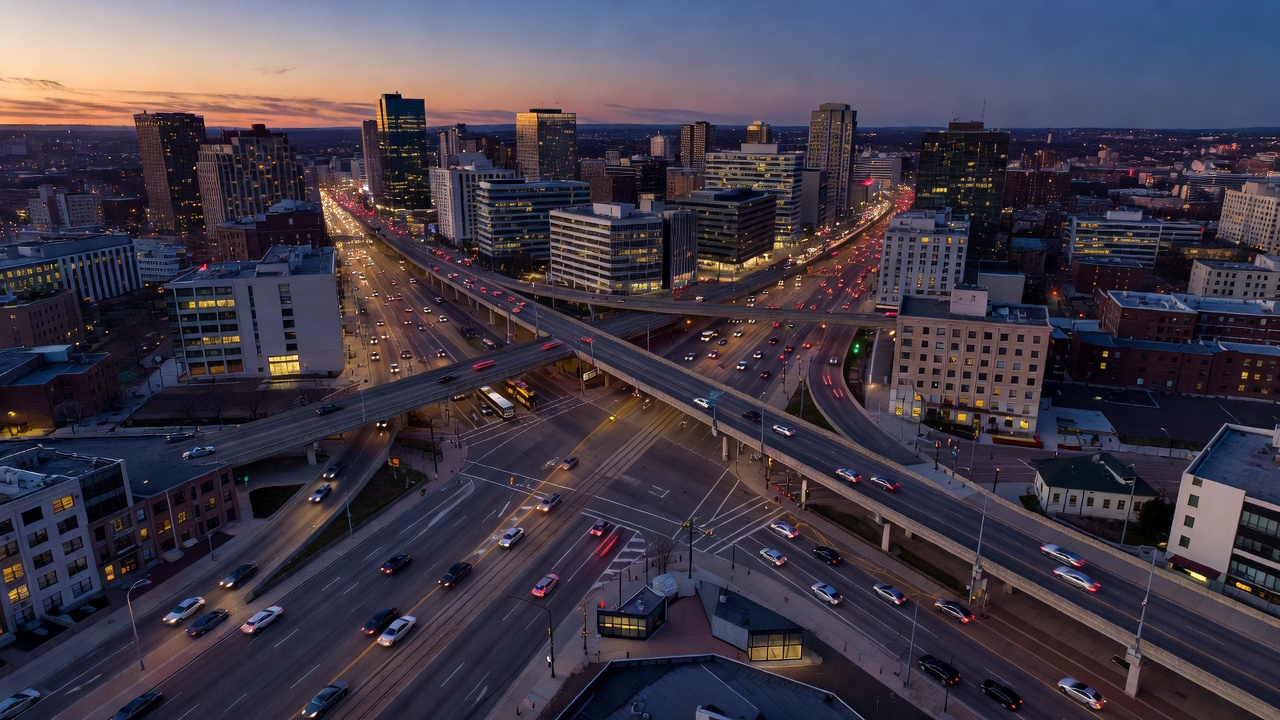
Traditional urban traffic management operates on predetermined time-of-day signal schedules or basic inductive loop sensors buried beneath the asphalt. These legacy systems are reactive and highly localized, incapable of responding to network-wide anomalies such as accidents, severe weather, or major public events. The deployment of Smart Traffic Management Systems leverages the Internet of Things (IoT), edge computing, and artificial intelligence to create dynamic, predictive routing environments.
Adaptive Traffic Control Systems (ATCS)
Adaptive Traffic Control Systems fundamentally shift signal logic from static timing plans to continuous, real-time adjustments. By ingesting data from multiple intersections along a corridor, the ATCS algorithm calculates the optimal phase split (the allocation of green time) and offset (the timing relationship between adjacent signals) to maximize vehicular throughput and minimize idle time.
The underlying processing requires substantial computational power. Because centralized cloud processing introduces unacceptable latency for millisecond signal alterations, municipalities are deploying edge-computing nodes directly inside roadside traffic cabinets. These ruggedized servers process localized data and only transmit aggregated metadata to the central traffic management center (TMC).
Sensor Technologies and Computer Vision
The efficacy of an ATCS is entirely dependent on the quality and granularity of its input data. Municipalities are replacing single-point inductive loops with comprehensive sensor arrays:
- Optical Camera Networks: High-definition cameras feeding edge-deployed computer vision models. Unlike simple motion detectors, these models can classify actors (distinguishing between passenger cars, heavy trucks, cyclists, and pedestrians), allowing for nuanced prioritization.
- Thermal Imaging: Provides reliable pedestrian detection at crosswalks during nighttime or severe weather events where optical cameras fail.
- Bluetooth/Wi-Fi Sniffers: Passive sensors that detect the MAC addresses of in-car devices to calculate aggregate travel times between two points on an arterial road without identifying individuals.
Vehicle-to-Everything (V2X) Communication
The next iteration of traffic management involves direct communication between the infrastructure and the vehicles themselves. V2X relies on Dedicated Short-Range Communications (DSRC) or Cellular V2X (C-V2X) protocols broadcasting in the 5.9 GHz band.
V2X enables critical safety and efficiency applications:
- Signal Phase and Timing (SPaT): Intersections broadcast their current light phase and the precise countdown to the next change. Approaching vehicles can calculate optimal approach speeds to avoid stopping entirely, drastically reducing start-stop emissions.
- Emergency Vehicle Preemption (EVP): Ambulances and fire engines transmit a secure V2X signal requesting immediate priority. The ATCS seamlessly flushes traffic ahead of the emergency vehicle and holds cross-traffic, improving response times safely.
- Transit Signal Priority (TSP): Similar to EVP, but conditional. If a public transit bus is running behind schedule (determined by its GPS and timetable data), it can request a few seconds of extended green time to clear the intersection.
Implementation Challenges
Despite the theoretical benefits, rolling out smart traffic management involves significant hurdles. Municipal procurement cycles are slow, and legacy hardware is deeply entrenched. Furthermore, the reliance on continuous network connectivity creates cybersecurity vulnerabilities. Hardening roadside cabinets against physical tampering and securing V2X broadcasts against spoofing attacks requires enterprise-grade cryptographic key management systems operating at a municipal scale.